The media has had a tendancy to portray the practice of smoking as something that is beautiful, intriguing and wonderful. Many movie stars, celebrities, athletes and commercials tend to entice people to believe that smoking is the route to true happiness. Youth tend to look up to adults and especially the ones who are illuminated in the media. When their "hero" or "heroine" chooses to pursue dangerous activities and habits, the young people in society decide that they should be doing that too. Especially in the case of smoking, (a highly addictive habit) those who even try their first cigarette are doomed to live a life enslaved to their addictive passions. Not only does this affect their own health and lifestyle, they also inflict the same poisonous air on non-smoking citizens. This environmental tobacco smoke (ETS), or second hand smoke kills more than 53800 people per year, not to mention the 443,000 that die prematurely from their own smoking habits. What a horrific amount of deaths from something that citizens are inflicting upon themselves and on others around them. When you look at natural disasters and wars, there are rarely 496,800 deaths. Even more appalling is the fact that while we have no control over natural disasters, we could actually prevent this great disaster.
One of the most vulnerable victims is a young developing child.

A forming fetus, a child yet unborn, enveloped in the supposed safety of the womb, is completely dependent on its amniotic environment for life itself. And then, mother inhales her cigarette, and soon, the perilous effects of second-hand smoke are flowing through the baby’s blood, reducing the amount of oxygen in its circulatory system. Now, outside the womb, the helpless newborn is transferred to the relative security of the latest car seat for a supposed safe ride home. As a matter of habit, mother and father light up, and the baby’s first breaths are filled with insidious toxins. Once home, baby is placed in what should be the comfort of its crib, but instead, is imprisoned behind bars that make escape from second-hand smoke impossible. As baby grows from infancy into adolescence, the child remains enslaved, without the agency or ability to free itself from the addictive appetites of its adult overseers.
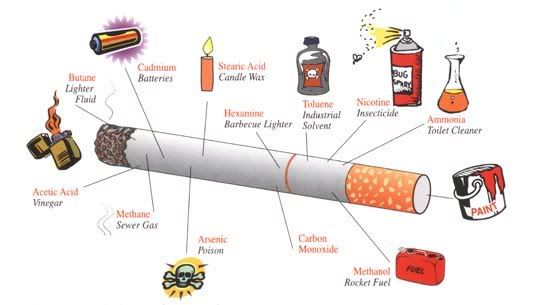
With every inhalation of a cigarette comes an exhalation. Breathe in—breathe out; such a simple act with such detrimental consequences. Each smoke-stained breath is filled with over four thousand chemicals including nicotine and carbon monoxide, which is poisonous gas contained in car exhaust fumes; formaldehyde, which is used to preserve dead specimens; and ammonia, which is used in household cleaners. Cigarette smoke also contains naphthalene, which is an ingredient in mothballs; arsenic, which is used in ant and rat poisoning; DDT, which is a banned insecticide; butane, which is gas used in lighter fluid; hydrogen cyanide, which is used in gas chambers; and at least forty-three cancer-causing toxins. As cigarette smoke enters the body, these toxins permeate the lungs, bones, brain, heart, and circulatory system (Ginzel). These are the facts that commercials in the media leave out. What if people really knew the truth about what they were breathing in?

It is appalling to think that any independent adult with an understanding of these facts would ever consider allowing these toxins to enter into their own body. It is even more abhorrent to think that any responsible adult would likewise consider inflicting these poisons upon an innocent child who is unable to choose for itself. And yet, it is estimated that more than 43 million adults and over 3.4 million high school students in the United States smoke cigarettes. Recent studies have shown that a typical smoker inhales an average of 300 puffs of smoke per day. As previously noted, with every inhalation of a cigarette comes an exhalation. That totals over 13,800,000,000 puffs of second hand smoke per day that is inflicted upon the non-smoking population (How). While adults often have the freedom to remove themselves from smoke-filled environments, children remain incarcerated in the poisonous environmental prison of second-hand smoke created by unthinking and uncaring adults

The fact that smoking is dangerous is an obvious fact to so many people,
yet thousands of people still continue to smoke as if there were no
consequences and those who do not smoke do not seem to be able to solve the
problem and keep children from being affected and from dying.
Who will be the next victim in this epidemic? Will there be a
rescue party in this disaster? Who will answer to the devastatingly high
amounts of death? How can this problem be solved? For some, the
first solution that comes to mind may be that the best way to protect
vulnerable children would be to enforce non-smoking laws in private areas,
similar to those that have been established in public places. This idea,
however pleasant and simple it sounds, would not be a true solution to the
problem because
although tobacco levels may decrease with time, by allowing the
government to regulate what adults
can and cannot do in their homes breaches sensitive and dangerous
territory leading to the possibility of
losing some of
our most precious and important rights.
There are many examples where good intentions of government legislation have gone awry. One example is the case of Parker Jensen.
In 2003, the media was highly involved in a case between the Jensen family and state legislation. Parker was diagnosed with a rare form of aggressive cancer called Ewing’s sarcoma. Although doctors and physicians highly recommended immediate treatments of chemotherapy, Parkers parents resisted the recommendation and wished to take care of their son in other ways at home. When they refused the treatments and did not show up on the scheduled day to begin the chemotherapy, the state went to take custody of Parker, but it was found that the Jensen family was not at home and had gone out of town. It was then that the state accused Parkers parents of kidnapping their own son. After many battles in court, the Jensen family finally had all sentences erased from their records. Later, it was realized that the treatments that were so heavily suggested were not even necessarily essential to Parkers recovery. Even without chemotherapy treatments, Parker is alive and well today. Daren Jensen, Parkers father, said, “It’s troubling that the state can exercise their will without any regard for parental decision… it puts our children in danger” (Sherman). Although Parkers circumstance turned out favorably, the idea of this case is far from over. In less intense situations, parents often face similar issues, and although legislation has good intentions, the results are often ineffective and even harmful. Because of complications and risks, having the government make decisions about what is happening in people’s private lives and what activities they involve themselves in is a dangerous solution that should not be considered. Since each set of parents has different traditions, habits, values and beliefs and should choose for themselves what they want to do.
Because legislation should not be involved in private decision making and will not be able to solve the problem of second hand smoke, the time has come for an education system to be put in place so that those who do not realize the severe consequences of second hand smoke will be able to gain an understanding of the dangers that come from environmental tobacco smoke (Secondhand). Throughout history, in countless situations, education has improved life quality and health conditions.
 One example of this is how education is affecting AIDS victims. AIDS have been a huge problem in societies all around the world for ages (Diseases). In the past thirty years, education systems have began to be established so that people could learn about the disease itself and what types of prevention and precaution they could take. Since people are becoming more educated and actually understanding what they are dealing with, AIDS victims have greatly decreased and safety measure have been taken to ensure that the disease will not be spread as far or occur as often. Treatments are also being found and learned about so that help will be available to those who have already fallen victim to the disease. Because measures have been and are being taken to teach adults and children how to be healthy and have good hygiene, the effects of the diseases and other related illnesses are being lessened and are able to be taken care of more quickly and efficiently. Also, with less people dealing with health problems, economies have improved because the costs in things like medical bills and healthcare are no longer needed in such large amounts. Of course AIDS are still a pressing issue that affects thousands of people, but the education provided has made a huge difference in helping improve the situation.
For a select few, it is just as easy to quit smoking, as it is to begin. For the rest of the not so luck smokers, once they take even their first puff of smoke, they become addicted and remain smokers for the rest of their lives.
 Nicotine is a very powerful chemical that can cause those who use it to feel calm and happy. This a major reason why people become so addicted to it. Also, because the affects wear off after about an hour, smokers feel irritable and upset until they smoke another cigarette. This is constantly causing nicotine levels to rise in a smokers blood system, which causes the craving for the nicotine to rise even higher (Hyde). Because of this enslaving cycle, it is extremely hard for addicts to completely quit smoking. However, if parents had a reason that was strong enough and a love deep enough for their children, the chances of them being able to quit would be much higher. Perhaps being educated on second hand smoke and the damaging effect is has on youth would form a feeling of motivation for the adult parents to create a better lifestyle and a cleaner environment of fresh, uncontaminated air for their children.
 In addition to teaching adults about diseases and health dangers, schools should also begin making education more readily available to young children. They would learn how important it is to refrain from trying even one cigarette. This education would be extremely beneficial because in their early years, children begin to understand things and form their own opinions. Even if their parents were addicted cigarette users, although children do not have the choice of where they live, or what kind of environment they are in when they are in their youth, young people should have the opportunity to choose for themselves what kind of lifestyle they want to follow and what habits they want to form as they grow into adulthood and prepare to raise children of their own.
Using forms of
educating to inform society about the hazardous affects of second hand smoke is
a much more reasonable and effective solution than forcing people to follow
legislative decisions. As humanity becomes more educated and aware,
they will be able to make more informed and intelligent decisions about what
they put into their own bodies and what they inflict on their
children. By becoming educated, society will be more prepared and
able to defend the defenseless by protecting children from the insidious
effects of second hand smoke.


No comments:
Post a Comment